
Building a strong pipeline of investors We provided a dedicated…
Read More
Empower Innovation, Drive Excellence, Enhance Growth.




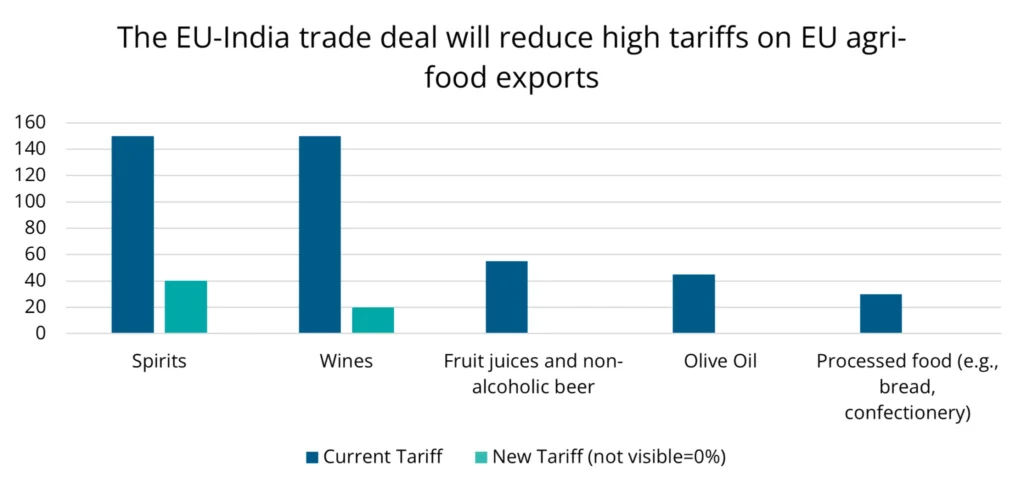
After nearly 20 years of negotiations and an estimated five more years required for full implementation, the India-EU Free Trade Agreement (FTA) will not result in dramatic price drops or an overnight market transformation the moment it takes effect. Social media is full of buzz about how much cheaper European products—such as cars, spirits, processed foods, and olive oil—will become in India once the agreement is active. While it is true that the agreement is expected to slash tariffs on wine from 150% to 20% and on automobiles from 110% to 40%, these reductions will be phased in gradually over several years.
However, what this agreement truly creates is a framework for long-term strategic positioning.
Many companies tend to have high expectations for FTAs, imagining immediate tariff benefits and seamless cross-border business. In reality, the process is more complex, time-consuming, and involves significant bureaucratic procedures.
Before the benefits of this agreement can materialize, it must undergo a process of incorporation into domestic law and parliamentary approval in both India and all 27 EU member states. Ratification requires coordination across numerous legislative bodies, each with its own domestic politics and priorities.
The real challenge is not the moment leaders sign the treaty, but the years of work that follow. India’s complex legal system must be aligned with the highly developed legal framework of the EU. For small and medium-sized enterprises (SMEs) without dedicated compliance teams, this can represent a significant burden.
If you are considering investing in business between India and the EU, you should look beyond simple changes in tariff rates and focus on the following points:
Regulatory certainty
A survey (FEBI) conducted in January 2026 among European companies operating in India showed that “regulatory predictability” was valued more highly than tariff reductions. Companies are less concerned with a 5% drop in tariffs than they are with whether the rules will change next month or next year.
This FTA is a mechanism through which India and the EU signal their intent to maintain a long-term foundation even as political climates shift. For companies planning investments on a five-year horizon, this stability is of immense value.
95% expansion intent
According to FEBI, approximately 95% of European companies already operating in India plan to expand their operations over the next five years. This is not mere optimism; it is a demonstration of strong confidence from companies doing business on the ground.
Varying impact by industry
Not all industries will benefit equally. Expectations are particularly high in the following sectors:
When making investment decisions, it is crucial to look at where the capital is flowing rather than just following the news.
Major multinational corporations are already making preparations. To adapt to the FTA, they are analyzing Rules of Origin (such as CTC and value-added criteria) and establishing systems to centralize supplier information and certifications.
On the other hand, many SMEs lack specialized legal teams and may struggle to meet the EU’s complex requirements for certification, inspection, and traceability. However, it is these SMEs that support India’s manufacturing ecosystem.
For investors, this represents both a risk and an opportunity.
Companies that successfully navigate compliance in the early stages may gain a significant first-mover advantage.
The significance of this agreement lies more in its geopolitical context than in its economic minutiae. As supply chains continue to restructure, this FTA serves to provide a stable foundation for business.
The EU’s perception of India has changed significantly over the past decade. This is not a new relationship, but an evolution into a deeper strategic partnership.
This agreement is not just a policy change; it is a structure for growth over the next 10 to 20 years.
1. Develop scenario-based strategies
Plans must account for multiple scenarios, including potential delays in ratification. It is also vital to move forward early with supplier selection and preparation for certificates of origin.
2. Legal and compliance preparation
It took IKEA 12 years to enter the Indian market. Following changes to foreign investment regulations in 2012, they engaged in extensive discussions with regulators before opening their first store in 2018.
For a company to succeed, understanding the regulatory environment and engaging in long-term preparation is essential.
3. Site selection
Together, India and the EU account for approximately 25% of the world’s population and 25% of global GDP. According to official EU reports, exports from the EU to India are projected to increase by 107.6% by 2032.
Location is critical to gaining a competitive advantage.
By establishing a presence in the appropriate industrial clusters, companies can leverage specialized talent, suppliers, infrastructure, and incentives.
The India-EU FTA will not dramatically change short-term sales. It is unlikely to have an immediate impact on next year’s financial results.
However, this agreement provides a foundation for long-term, stable growth. With approximately 6,000 European companies already operating in India, this agreement is expected to create new opportunities across many industries.
95% of European companies in India are planning to expand.
They are investing with a long-term perspective.
The question is not whether this FTA is important.
The question is whether your company is thinking strategically on the same timeline.
For consultations regarding market entry or business expansion, please contact Tractus or our India Consulting Manager, Anand Verma (anand.verma@tractus-asia.com).

Building a strong pipeline of investors We provided a dedicated…
Read More
Overview An innovative biofertilizer manufacturer aimed to launch commercial operations…
Read More
A leading manufacturer and distributor of lubricants and automotive chemical…
Read More
After nearly 20 years of negotiations and an estimated five…
Read More